
Our models
Two ways to remove a tonne
Buy the removal from us, or make it inside your own operation and keep it. Same chain of proof, same certification, entirely different place on your balance sheet, and most buyers are never told the difference.
Model 01 · Offsetting
You buy the tonne
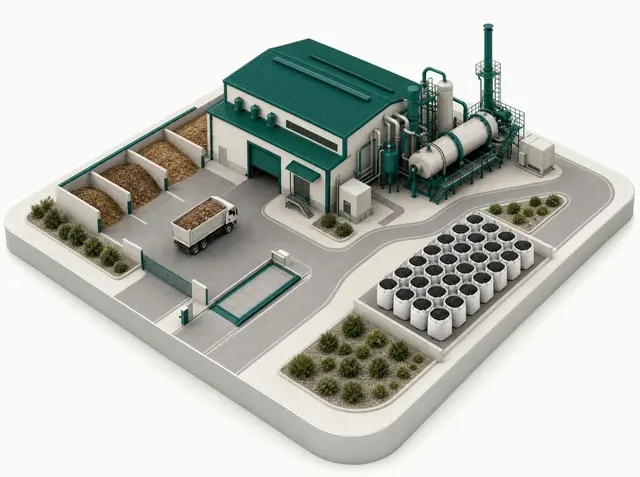
We develop our own biochar production facilities. We measure and document the CO₂ removals, which are verified by independent bodies before the certification programme issues the credits. Companies can buy these credits to support climate action beyond their own value chain.
We source the fire-risk residue and run it through our own facilities; an independent body verifies the removal, and the certification programme issues the serialised credit you buy. It is additional to your value chain: a contribution against the emissions you cannot eliminate. This is what most people mean when they say “carbon credit”.
Secure removalsModel 02 · Insetting
You keep the tonne
Units sited inside a partner's operation, converting their own residue. The removal lands in their value chain: their scope 3, not an open-market credit.
We site a unit at your operation and convert the residue you already produce. The removal lands inside your own footprint rather than being sold to anyone else, and the biochar and the process heat stay with you. If you have a biomass residue you currently pay to dispose of, this is the model that turns it into an asset.
A bought credit offsets emissions you report elsewhere; an inset tonne lowers the footprint of the product itself (your olive oil, your wine), counted in your own value-chain inventory, not someone else's.
Under the GHG Protocol's Land Sector & Removals standard (in force 2027), durable removals can be reported inside your value-chain inventory, separately from emissions, with no netting. Biochar's explicit eligibility is expected in the standard's guidance.
Discuss a unitSide by side
Which one is yours?
| Offsetting | Insetting | |
|---|---|---|
| Where does the removal happen? | At a Recarbono facility, on feedstock we source. | Inside your operation, on residue you already produce. |
| Who owns the tonne? | You buy it. A serialised credit is issued to you and retired on your claim. | You keep it. The removal is generated within your value chain and never enters the open market. |
| Where does it count? | Against residual emissions you cannot eliminate, a contribution outside your value chain. | Inside your own footprint, where value-chain emissions are accounted. |
| What do you supply? | Nothing. You contract for volume and a delivery window. | Your residue stream, a site, and an offtake for the biochar or the heat. |
| What do we supply? | The facility, the feedstock, the certification and the credit. | The unit, the measurement chain, the certification and the operating know-how. |
| Who is it for? | Buyers with a residual footprint and a durable-removal mandate. | Operators with a biomass residue problem: agri-industry, forestry, food processing. |
Both models run on the same chain of proof: the same H/C gate, the same accredited laboratories, the same conservative accounting. Only the commercial shape differs.
How we contract
Definitions in the glossary; no price numbers anywhere. Pricing is agreed per contract.
In the pipeline
Where each model is being built
Offsetting
Insetting