
Engineering · Nut processors
Nut shells, the residue pyrolysis was made for
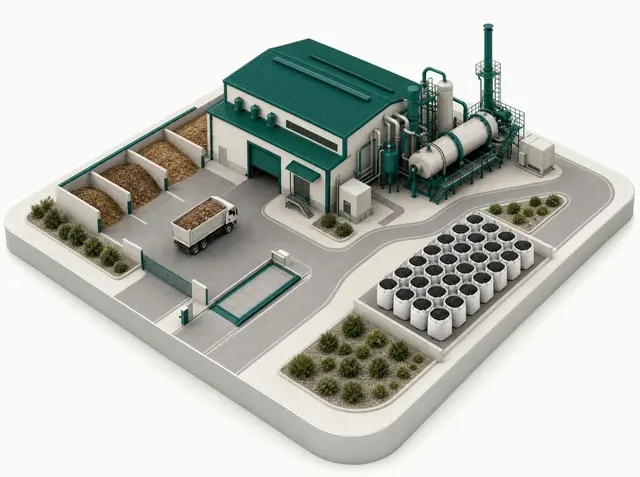
Almond, walnut and hazelnut shells are dry, uniform and rich in carbon: the strongest technical fit of any residue we list. A pyrolysis unit behind the cracking line turns them into biochar, a durable carbon removal, and, for once, surplus heat your plant can actually use.
This page is still the honest version, just a happier one. On wet streams we tell mill owners the heat goes into drying; on shells, at around 10% moisture, it does not. The energy case is real. One honesty remains: if you already sell shells as boiler fuel, the comparison is carbon plus heat against that fuel sale, not against a disposal bill, and we run that arithmetic with you, not past you.
The arithmetic
What your shells become
Shells arrive at around 10% moisture, so nearly every tonne is dry matter and the drying penalty that dominates pomace and marc barely exists. Biochar comes out at 25–30% of dry matter, and each tonne of it holds 1.9–2.3 tonnes of CO₂e, the full woody range, because shell char runs low in ash and high in fixed carbon.
The panel shows 2,000 tonnes of shells a year, roughly what a mid-sized hulling and cracking operation sheds, since shell is half or more of the weight of in-shell almonds, and a scale ever more common in Iberia as the Alqueva-era orchards come into full production. Same factors as the estimator on our engineering page, including a permanence factor of 0.80 for Portuguese soil temperatures. These are design estimates: the assessment measures your actual material.
Indicative: 2,000 t of shells
- Biochar produced
- 450–540 t
- Durable CO₂ removed
- 860–1,240 tCO₂e
- Recoverable heat
- 1,630–2,530 MWh
- Residue mass removed
- ~1,510 t
25–30% of dry matter: a dense, low-ash, carbon-rich char.
Durable for several centuries (CORC200+), net of lifecycle emissions.
Usable as hot water, steam or drying heat. On shells, the surplus is real, not a brochure promise.
Mass in, minus biochar out: around three-quarters, less than a wet stream loses, because shells bring no water to evaporate.
How it works
A unit that finally exports heat
01
Receive
Shells arrive as they leave the cracking line, dry enough that the dryer has almost nothing to do, which is exactly why the heat balance works here.
02
Pyrolyse
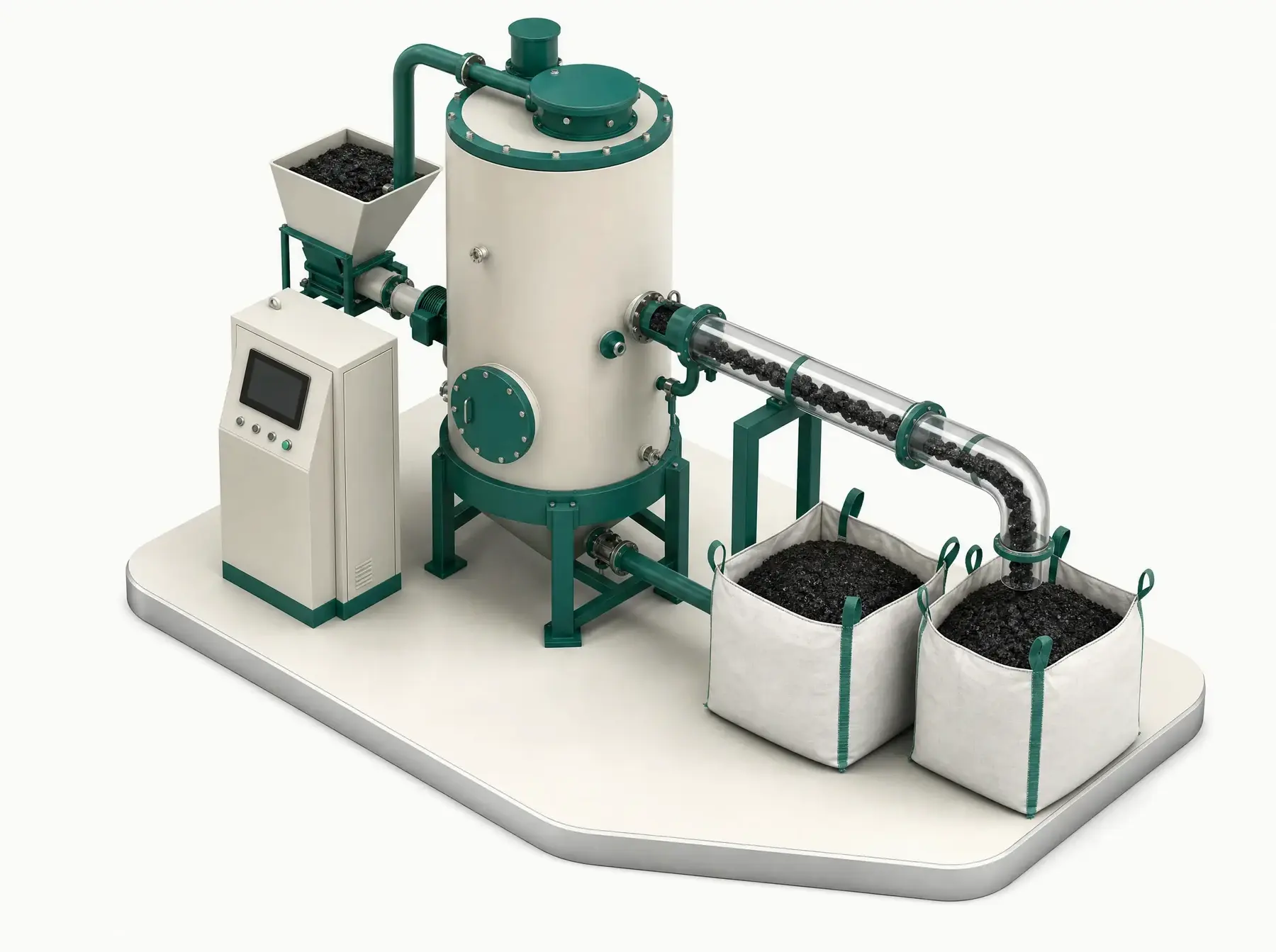
The shells are heated without oxygen. Instead of burning, they decompose: gas is drawn off and burned to power the process, and the carbon skeleton remains as biochar.
03
Collect
Biochar discharges into big bags, and the process gas returns more heat than the feed needs: the surplus exports to your plant as hot water, steam or drying heat.
04
Record
Every batch is logged as it happens (feedstock in, char out, samples to the laboratory), so the removal can be certified rather than merely claimed.
Two ways to own it
Buy the unit, or buy the outcome
Equipment supply
You own the unit
We design, deliver and commission a unit sized to your volumes, train your team and stay on for support. The capital investment is yours, and so are the biochar, the surplus heat and the carbon.
Your capex · your operation · full upside
Build-Own-Operate Agreement
We run it at your plant
No capital outlay: we finance, build, own and operate the unit at your site, and you pay per tonne of shells processed. Your benchmark is honest: what your shells earn as fuel today, against biochar, heat and a removal in your own name. The outputs are still yours.
No capex · per-tonne fee · you keep the outputs
Keeping the removal inside your own footprint is insetting, and the vocabulary (offsetting, insetting, durability) is defined in plain terms in the glossary.
The carbon story
A removal your almonds can claim
Shell biochar locks its carbon away for several centuries (the CORC200+ durability class). That removal can go one of two ways: certified and sold as carbon credits, or kept inside your own footprint (insetting), so the nuts you ship carry a measured removal from their own shells. One or the other, never both.
Built into every unit
- Feedstock intake records (origin, mass, moisture), captured digitally at the plant.
- Batch-level data and accredited laboratory analysis, mapped to the EBC and registry methodologies.
- The removal counted in your nuts' footprint, or certified as credits, your choice, evidenced either way.
Where we stand: our first industrial facility is in development, first production is planned for 2027, and no client units have shipped yet. Engineering assessments are open now, and early clients set the queue.
Size it for your tonnes
The estimator on our engineering page runs the arithmetic above against your own volume, pre-set to shells, and for once the heat row is not zero.
Open the estimatorFAQ
What nut processors ask us
Six questions we hear from processors, starting with the shells you already sell.
How an assessment works
Four steps, no fee to find out
01
One call
Residue type, rough tonnes per year, moisture and season, what you do with heat today. Thirty minutes.
02
Site visit
We sample the material and walk the space, access and connections with you.
03
The assessment
A written design estimate: unit envelope, biochar output, exportable heat, mass reduction, CO₂e. Figures you can hold us to.
04
Your decision
Buy the unit, or we build and run it at your site. Either way, the carbon stays yours.
Tell us about your shells
Tonnes per year, what they earn today, and where the plant is: the assessment starts there, and it costs you nothing.
Request an assessment