
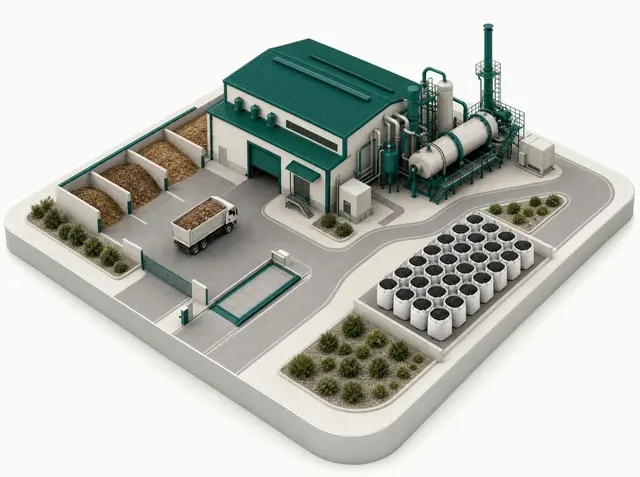
Engineering · Wineries & quintas
Grape marc, dealt with at the winery
Every vintage ends the same way: the press empties, and wet, fermenting tonnes of skins, seeds and stalks are yours to deal with, against a waste tax that stands at 40 € a tonne in 2026 and is legislated to reach 60 € by 2030. A pyrolysis unit at the winery turns most of that mass into water vapour and biochar, and the end-of-vintage headache into a carbon removal in your wine's own name.
This page is the honest version. Marc is roughly half water, which puts it right at the drying break-even: the unit's recovered heat mostly goes into drying the marc itself, so plan on residue treatment and carbon, not on energy. Vine prunings are the stream that changes that arithmetic (more below).
The arithmetic
What your marc becomes
Fresh marc leaves the press at around 55% moisture, wetter than any brochure admits, drier than olive pomace. Biochar comes out at 25–32% of the dry half, and each tonne of it holds 1.7–2.1 tonnes of CO₂e, a touch below the woody range, because marc char carries more ash and mineral salts.
The panel shows 1,200 tonnes of fresh marc, about what a cooperative-scale winery crushing five thousand tonnes of grapes is left with, since marc runs at a fifth to a quarter of what crosses the weighbridge. Same factors as the estimator on our engineering page, including a permanence factor of 0.80 for Portuguese soil temperatures. These are design estimates: the assessment measures your actual material.
Indicative: 1,200 t of fresh marc
- Biochar produced
- 140–170 t
- Durable CO₂ removed
- 230–360 tCO₂e
- Recoverable heat
- 0–200 MWh
- Residue mass removed
- ~1,050 t
25–32% of dry matter: a stable, mineral-rich char.
Durable for several centuries (CORC200+), net of lifecycle emissions.
Marc sits at the drying break-even: budget zero, and treat anything above it as a bonus.
Mass in, minus biochar out: the number your end-of-vintage clean-up cares about.
How it works
A unit made for the end of vintage
01
Receive & dry
Marc arrives as it leaves the press. The unit's recovered heat drives a dryer that brings the moisture down until the material can sustain pyrolysis. At 55% moisture, this is where most of the energy goes.
02
Pyrolyse
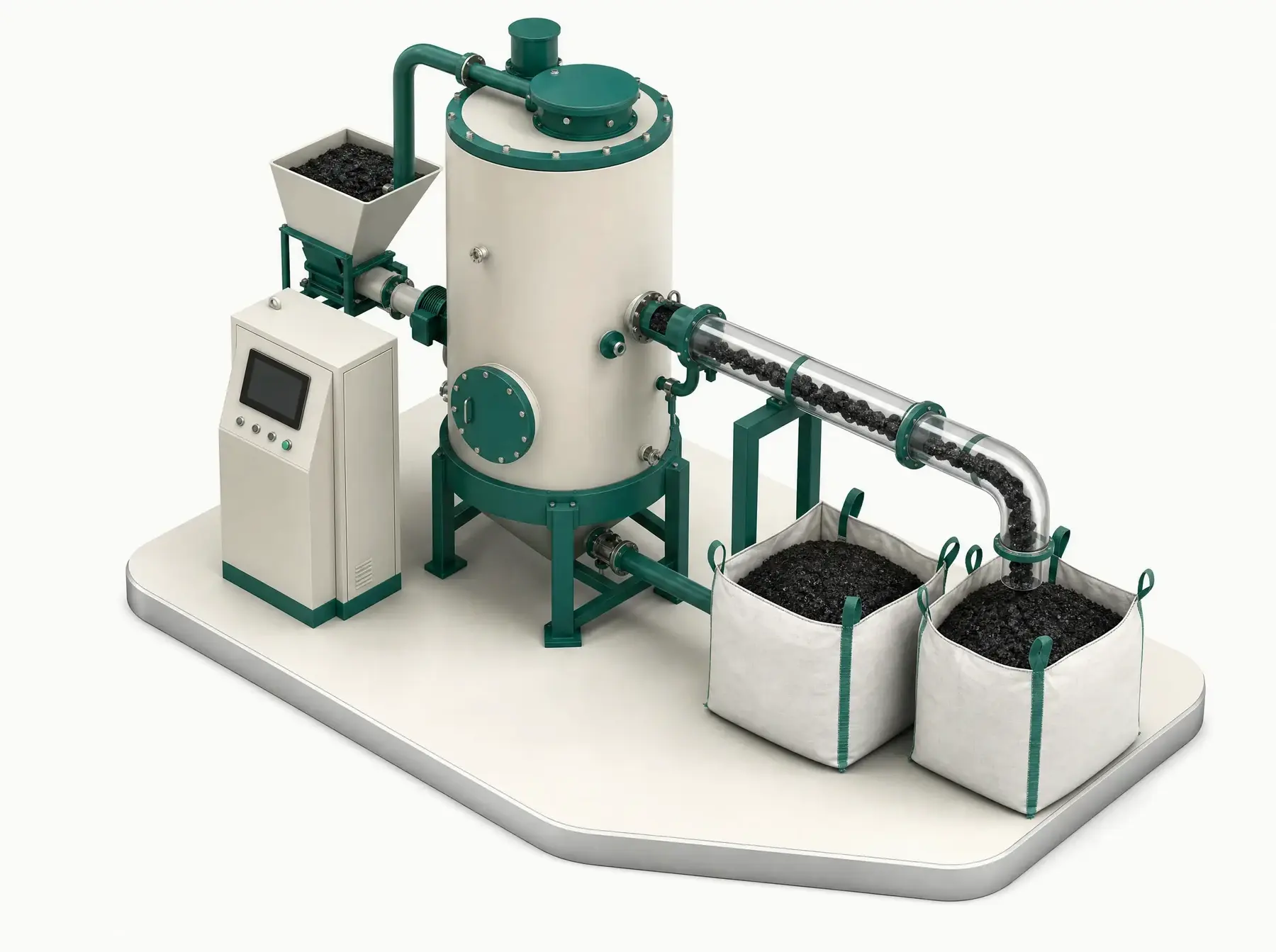
The dried marc is heated without oxygen. Instead of burning, it decomposes: gas is drawn off and burned to power the process, and the carbon skeleton remains as biochar.
03
Collect
Biochar discharges into big bags: a dry, stable material at roughly an eighth of the fresh mass you started with. The rest left as water vapour and process gas, not on a lorry.
04
Record
Every batch is logged as it happens (feedstock in, char out, samples to the laboratory), so the removal can be certified rather than merely claimed.
Two ways to own it
Buy the unit, or buy the outcome
Equipment supply
You own the unit
We design, deliver and commission a unit sized to your vintage, train your team and stay on for support. The capital investment is yours, and so are the biochar, the heat balance and the carbon.
Your capex · your operation · full upside
Build-Own-Operate Agreement
We run it at your winery
No capital outlay: we finance, build, own and operate the unit at your site, and you pay per tonne of marc processed. Your benchmark is what handling and disposal cost you today, a figure already legislated to rise. The outputs are still yours.
No capex · per-tonne fee · you keep the outputs
Keeping the removal inside your own footprint is insetting, and the vocabulary (offsetting, insetting, durability) is defined in plain terms in the glossary.
The carbon story
A removal your wine can claim
Marc biochar locks its carbon away for several centuries (the CORC200+ durability class). That removal can go one of two ways: certified and sold as carbon credits, or kept inside the wine's own footprint (insetting), so the bottle that leaves your winery carries a measured removal from its own marc. One or the other, never both.
Built into every unit
- Feedstock intake records (origin, mass, moisture) captured digitally at the winery.
- Batch-level data and accredited laboratory analysis, mapped to the EBC and registry methodologies.
- The removal counted in your wine's footprint, or certified as credits. Your choice, evidenced either way.
Where we stand: our first industrial facility is in development, first production is planned for 2027, and no client units have shipped yet. Engineering assessments are open now, and early clients set the queue.
Size it for your tonnes
The estimator on our engineering page runs the arithmetic above against your own volume, pre-set to fresh marc, and honest about the heat.
Open the estimatorFAQ
What wineries ask us
Six questions we hear from wineries and quintas, including the one about the distillery.
How an assessment works
Four steps, no fee to find out
01
One call
Residue type, rough tonnes per year, moisture and season, what you do with heat today. Thirty minutes.
02
Site visit
We sample the material and walk the space, access and connections with you.
03
The assessment
A written design estimate: unit envelope, biochar output, exportable heat, mass reduction, CO₂e. Figures you can hold us to.
04
Your decision
Buy the unit, or we build and run it at your site. Either way, the carbon stays yours.
Tell us about your marc
Tonnes per vintage, what you do with it today, and where the winery is: the assessment starts there, and it costs you nothing.
Request an assessment