
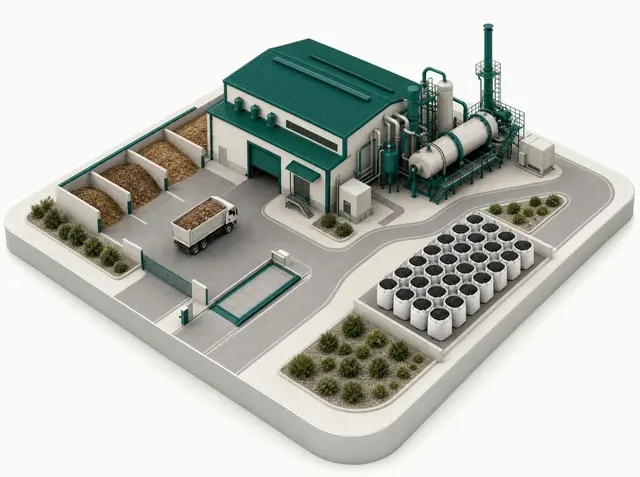
Engineering · Cork industry
Cork residue, measured before promised
Portugal transforms more cork than any other country on earth, and every stage of that industry sheds material: dust from sanding and cutting, trimmings, granulate fractions outside specification. Most of it burns today in the industry's own boilers. Pyrolysis puts a different question on the table: which of those streams is worth more as stored carbon than as fuel?
This page is the honest version, honest enough to have no numbers on it. The published pyrolysis data for cork is thin, and we do not publish design ranges we cannot stand behind. What you will find instead is what we know, what we measure, and why the estimator deliberately refuses to guess.
What we know
Dry, carbon-rich. And unmeasured
Cork residue starts from a strong position: it arrives dry (around 12% moisture, so none of the drying penalty that wet agro-food streams pay), and cork's suberin- and lignin-rich structure is exactly the kind of material that pyrolyses well in principle.
In principle is not a design range. Much of the industry's residue is not natural cork but resin-bound agglomerate, which the certification standards restrict; and the published data on cork pyrolysis yields is too thin to underwrite. So Recarbono publishes no yield, carbon or heat figures for cork yet. The assessment measures your actual material, and the numbers we eventually give you will be yours, not a brochure's.
No design ranges yet, by choice
What we know
- Dry, at around 12% moisture, no drying penalty.
- Suberin- and lignin-rich: a structure that favours a stable, carbon-rich char.
- Large, consistent streams: dust, trimmings and out-of-spec granulate from a world-leading industry.
What the assessment measures
- Which stream is which: natural cork dust versus resin-bound agglomerate, which the certification standards restrict.
- Your material's actual pyrolysis behaviour (yield, carbon content, contaminants), measured in the laboratory, not modelled.
- The residue hierarchy: which streams should keep firing your boilers, and which are worth more as stored carbon than as fuel.
How it works
What a unit would do, once your stream is measured
01
Characterise
We sample each stream separately (dust, trimmings, granulate) and the laboratory distinguishes natural cork from resin-bound agglomerate and measures what each one actually yields.
02
Pyrolyse
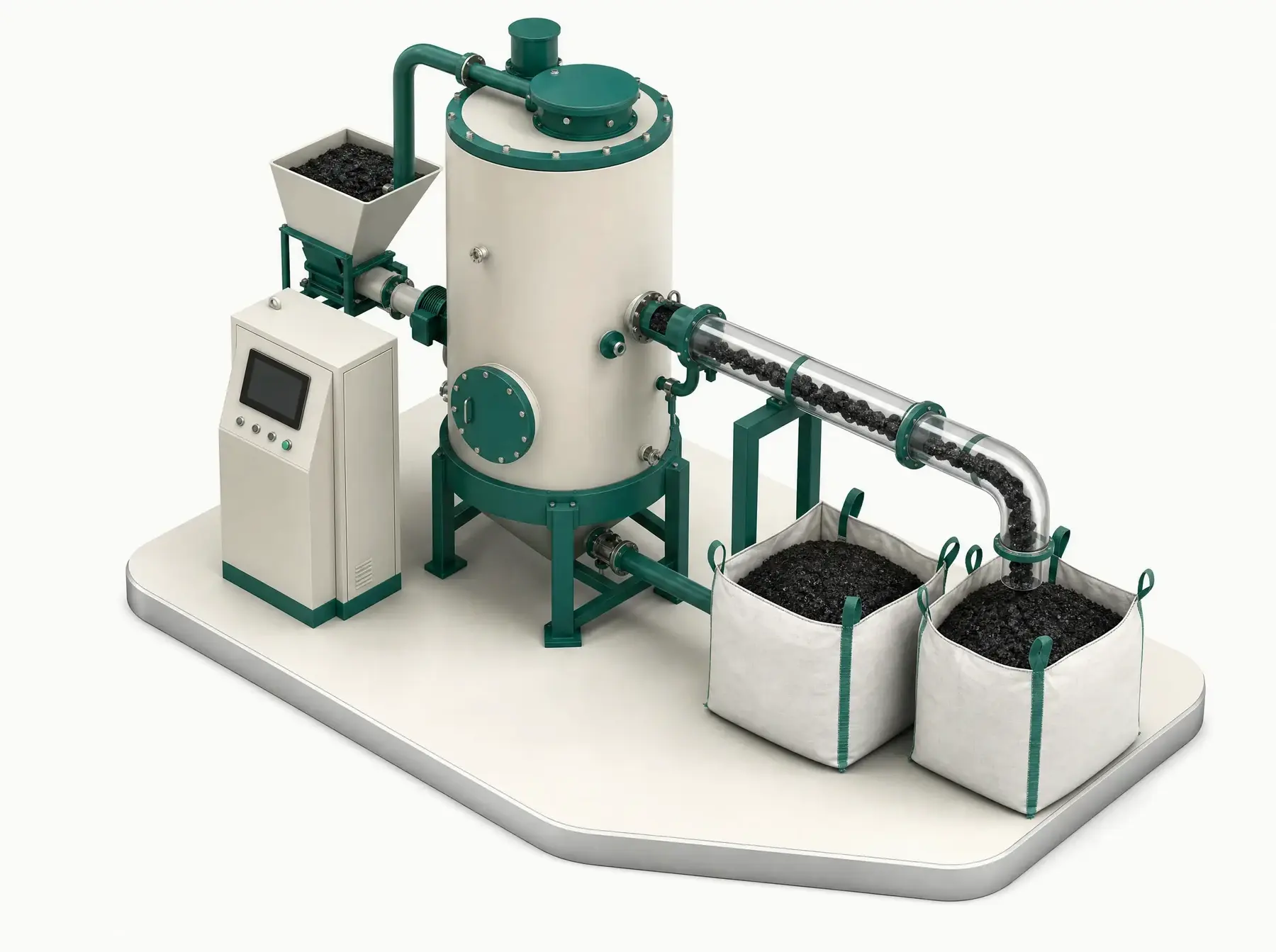
The material is heated without oxygen. Instead of burning, it decomposes: gas is drawn off and burned to power the process, and the carbon skeleton remains as biochar.
03
Collect
Biochar discharges into big bags: a dry, stable material at a fraction of the mass that went in. The rest left as process gas, not up a boiler stack.
04
Record
Every batch is logged as it happens (feedstock in, char out, samples to the laboratory), so the removal can be certified rather than merely claimed.
Two ways to own it
Buy the unit, or buy the outcome
Equipment supply
You own the unit
We design, deliver and commission a unit sized to your streams, train your team and stay on for support. The capital investment is yours, and so are the biochar, the heat balance and the carbon.
Your capex · your operation · full upside
Build-Own-Operate Agreement
We run it at your plant
No capital outlay: we finance, build, own and operate the unit at your site, and you pay per tonne processed. Your benchmark is honest: for a stream you burn today it is the fuel value you would forgo; for a stream you pay to send away, it is that cost. The outputs are still yours.
No capex · per-tonne fee · you keep the outputs
Keeping the removal inside your own footprint is insetting, and the vocabulary (offsetting, insetting, durability) is defined in plain terms in the glossary.
The carbon story
Carbon your cork products could claim
When a cork stream passes characterisation, its biochar locks carbon away for several centuries (the CORC200+ durability class), like any biochar certified under the same methodology. That removal can be certified and sold as carbon credits, or kept inside your own footprint (insetting), so the cork you ship carries a measured removal from its own residue. One or the other, never both. The conditional is deliberate: for cork, the claim starts in the laboratory.
Built into every unit
- Feedstock intake records (origin, mass, stream classification), captured digitally at the plant.
- Batch-level data and accredited laboratory analysis, mapped to the EBC and registry methodologies.
- The removal counted in your products' footprint, or certified as credits, your choice, evidenced either way.
Where we stand: our first industrial facility is in development, first production is planned for 2027, and no client units have shipped yet. Engineering assessments are open now, and early clients set the queue.
See the estimator refuse to guess
The estimator on our engineering page covers ten residues. Select cork and it gives you no numbers. It shows the same 'we would rather measure than guess' answer this page just gave you, and a route to the assessment that produces real ones. That refusal is the point.
Open the estimatorFAQ
What the cork industry asks us
Five questions we hear from cork processors, starting with the one about the missing numbers.
How an assessment works
Four steps, no fee to find out
01
One call
Residue type, rough tonnes per year, moisture and season, what you do with heat today. Thirty minutes.
02
Site visit
We sample the material and walk the space, access and connections with you.
03
The assessment
A written design estimate: unit envelope, biochar output, exportable heat, mass reduction, CO₂e. Figures you can hold us to.
04
Your decision
Buy the unit, or we build and run it at your site. Either way, the carbon stays yours.
Tell us about your streams
Dust, trimmings or granulate, rough tonnes a year, and what burns today: the assessment starts there, and it costs you nothing.
Request an assessment